
Guidelines on Preservation of Sample Integrity prior to analysis
Preservation of sample integrity is the set of practices, covering homogeneous sample collection, proper labeling, protective packaging and transport, and correct pre-treatment on receipt, that ensure a sample remains representative and stable before laboratory analysis.
Sampling plays a crucial role and deserves the same degree of attention as final analysis. Unfortunately, more than often the responsibility for sample collection and packing for despatch is entrusted to untrained persons and this can contribute to the poor reliability of results for which the analyst gets blamed though he is not at fault.
Ideally, the analyst who is aware of sample characteristics and necessary precautions required for the collection, packing, storage and transfer of the sample to the laboratory for testing should be involved but this is not practical as the testing laboratory could be located a considerable distance away from the sampling site. The solution to the problem lies in imparting required training to the samplers. The sampling personnel should be made aware of the following aspects of sampling so that they adopt the required precautions in collection and handling of samples.
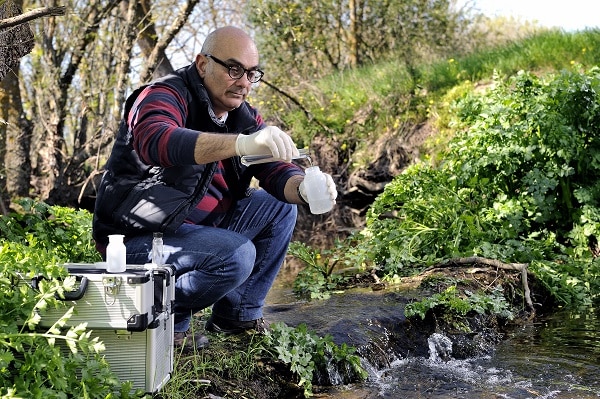
Collecting stream water sample for environmental pollution testing
Homogeneity of samples
The collected sample should be representative of the whole. The sampling source could be homogeneous or non-homogeneous so the sampler should ensure homogeneity of a sample before despatch for analysis. This requires the collection of different aliquots from different sampling points and mixing before drawing a representative sample for analysis. If this is not done the sample will not be representative of the source and analysis results will be of little significance.
Labeling
The samples need to be collected in inert containers and sealed properly before despatch to the laboratory for testing. It is equally important to label them properly and the label should be legible. It should carry sample name, source, date of sampling and other relevant sample information. The sampler should be made aware of stability features of different samples so that collected samples are stored under the required storage conditions.
Despatch to testing laboratories
The sample vials, plastic packs or bottles need to be securely packed into larger cartons with adequate packing material so that damage, breakages or spillages are avoided during transportation. In case samples are temperature sensitive they should be transported in refrigerated carriers or individual packs should be insulated inside vessels containing dry ice. If such precautions are overlooked sample degradation can occur during transportation. In addition, some unstable samples may require appropriate dosing of anti-oxidants or antibacterials.
Sample pre-treatment prior to analysis
On receipt, the analyst should reconfirm the sample homogeneity. This requires random mixing of contents if the same sample is received in more than one container and drawing a sample only after re-homogenization. Temperature or light sensitive samples need to be stored in amber colored bottles or vials and preserved in refrigerator or freezers prior to analysis.
Several automated sample handling and extraction aids are available these days which contribute considerably to the reduction of errors due to manual sample handling and also significantly increase laboratory throughputs. The final objective of the analyst is to extract the analyte of interest from the sample matrix to reduce interferences from matrix components and to dilute or pre-concentrate so that the concentration of the analyte falls within the measurement range of the analysis technique adopted.