
Temperature and Humidity
Temperature and humidity monitoring is the practice of tracking and controlling these two environmental parameters in a laboratory, alongside maintaining a dust-free environment, to ensure reproducible test results and support the comfort and efficiency of laboratory workers.
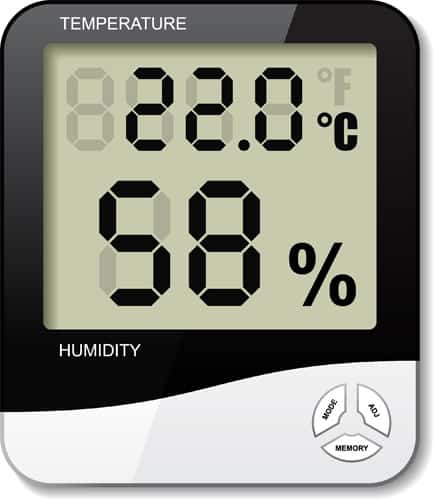
Temperature and Humidity monitor display
In addition to a dust free environment temperature and humidity are important parameters that require to be controlled in the laboratory. Apart from contribution to comfort and efficiency of laboratory workers control of these parameters contributes to a high degree of reproducibility of test results.
The main reasons justifying control and monitoring of temperature and humidity are:
- Calibration and operation of sophisticated instruments
- Calibration of volumetric apparatus
- Storage of standard weights and reference materials
- Stability studies
- Microbial growth studies
- Reaction Kinetics studies
Calibration and operation of sophisticated instruments
All instrument manufacturers recommend an optimum temperature and humidity range within which the instruments should be operated. Certain instruments are sensitive to both temperature and humidity changes as such changes can influence behavior of optical coatings, electronics and mechanical components. Both calibration and routine operation can show variances resulting in non-reproducibility of results
Calibration of Volumetric Glassware
All analysis requires reproducible transfer of volumes. Glassware calibration is carried out at 25°C +/-2°C. Glass at this temperature has very low coefficient of thermal expansion but liquid medium used for calibration can show significant volume variation per degree centigrade change of temperature.
Storage of standard weights and reference materials
Standards for calibration purpose such as weights or optical filters require careful handling and storage. Variations in humidity outside permissible limits can lead to gradual corrosion damage or deterioration of reference materials. Certified results of analysis of reference materials cannot be guaranteed if temperature and humidity are not maintained.
Stability Studies
Shelf life of pharmaceuticals and food products are dependent on temperature and humidity conditions of storage. Accelerated Stability studies on such products are conducted in specially designed stability chambers where both temperature and humidity are controlled over extended periods of time ranging from days to several months.
Microbiological Decay
Studies on growth of microbe colonies on specimens of foods or pharmaceuticals requires incubation under controlled temperature and humidity for specified number of days
Reaction Kinetics Studies
The reaction rates of chemical and enzyme controlled biochemical processes are significantly altered by temperature changes. Strict control of temperature is necessary for reproducible kinetic studies of such reactions
How to monitor temperature and humidity?
Temperature and humidity are monitored by recording continuously or at least twice a day at beginning and end of the day using calibrated thermometers and hygrometers. Digital recording and data logging devices are also reliable and widely used in modern laboratories.
Why are temperature and humidity monitoring critical in a laboratory?
Controlling temperature and humidity, along with maintaining a dust-free environment, contributes to a high degree of reproducibility of test results and to the comfort and efficiency of laboratory workers.
How does temperature affect the calibration and operation of laboratory instruments?
Instrument manufacturers recommend an optimum temperature and humidity range for operation, since sensitive instruments can show changes in optical coatings, electronics, and mechanical components outside this range, leading to non-reproducible results during both calibration and routine use.
At what temperature is volumetric glassware calibrated?
Volumetric glassware is calibrated at 25 degrees C plus or minus 2 degrees C. Glass has a very low coefficient of thermal expansion at this temperature, but the liquid medium used for calibration can still show significant volume variation per degree of temperature change.
What happens if humidity is not controlled during storage of reference materials?
Variations in humidity outside permissible limits can cause gradual corrosion damage or deterioration of standard weights, optical filters, and other reference materials, meaning certified analysis results for these materials cannot be guaranteed if temperature and humidity aren't maintained.
Why do stability studies require controlled temperature and humidity?
The shelf life of pharmaceuticals and food products depends on storage temperature and humidity, so accelerated stability studies are conducted in specially designed stability chambers where both parameters are controlled over extended periods ranging from days to several months.
How should temperature and humidity be monitored in a laboratory?
Temperature and humidity should be monitored continuously, or at minimum twice a day at the beginning and end of the working day, using calibrated thermometers and hygrometers, with digital recording and data logging devices also widely used in modern laboratories.