
Time for review of analytical chemistry course curriculums
A review of analytical chemistry course curriculums is an examination of how academic programs teach the subject, prompted by the observation that most university syllabi remain unrevised for years and emphasize theoretical topics such as titrimetric analysis, gravimetry, electrochemical methods, and chromatographic and spectroscopic studies at the expense of hands-on, industry-oriented training.
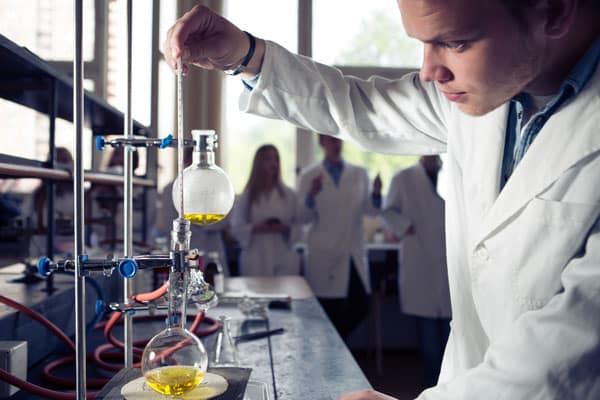
Analytical Scientist at work
Analytical chemistry offers numerous career options in industry, laboratories and academic institutions. This has been possible due to growing demand for mass produced consumer goods and increasing concerns for quality. In addition to quality of products analytical chemistry also contributes significantly to development of new materials with required properties.
In earlier days and even to this day majority of colleges offer graduate and post graduate courses in chemistry covering, mainly, the three branches of chemistry, namely, organic, inorganic and physical chemistry. Some colleges introduced bio-chemistry as it contributes largely to our understanding of chemical basis of life and living organisms mechanism. All branches of chemistry have contributed to our understanding of matter, interaction among atoms and molecules, reaction kinetics and characterization of properties of materials. On the other hand analytical chemistry is concerned about the application of physico-chemical properties of substances to carry out both qualitative and quantitative estimations on the components of different materials. Such studies find use in routine quality control applications, assignment of acceptable limits and development of materials with desired properties.
Keeping in mind the demands of the modern day society and its needs several academic institutions included specialized courses on analytical chemistry. However, the syllabus followed in majority of universities has remained unrevised for years together and covers mostly theoretical aspects of titrimetric analysis, gravimetry, electrochemical methods of analysis, chromatographic separations and spectroscopic studies. It is no doubt essential to have a good theoretical knowledge on concepts as it helps build a strong foundation for the analytical chemist. But, there is an emerging need to develop a sound grasp over practical aspects of the subject. It would be a good idea for all institutions offering analytical chemistry as a specialization to tie up with any local laboratory or industry for greater interaction with industry. Another important suggestion is that colleges located close to refineries, metal extraction units, mines, water treatment plants, pharmaceuticals, food, petrochemicals, fertilizers, etc., can introduce special topics on analysis of such products so that students after graduation stand better employment prospects in their neighbourhood.
It is a true that due to their prohibitive cost all educational institutions cannot afford highly sophisticated analytical instruments but with changing times it is a necessity for students to get exposure to such facilities. This objective can be easily achived through industrial or laboratory visits and interaction of students with industry experts. This approach will go a long way to motivate students to opt for analytical chemistry as a lucrative career option.