
Which is the right balance for weighing my sample?
In day to day analysis your weighing requirements will depend on quantity of sample available, sensitivity of weighing balance and the sensitivity of the analytical technique. The three types of digital display balances in common use in most of the laboratories are
| 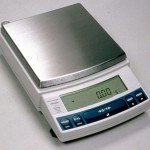
Top Pan balance Range: g - Kg | 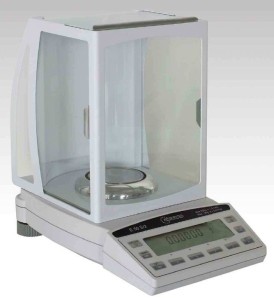
Analytical Balance Range : 0.1mg - 220g | 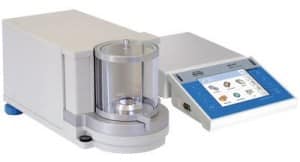
Micro Balance Range: 10⁻⁶ - 5g | | --- | --- | --- |
Top Pan Balance
A Top Pan Balance is used mainly for rough weighing for preparation of reagents and stock solutions where slight weight variations do not have significant influence on the result of analysis.
Electronic Analytical Balance
Majority of times you will find an electronic analytical balance suitable for weighing your samples and reference standards. The readability or least count of such balance is 0.1mg or 0.0001gm.
Micro Balance
A Micro Balance provides the ultimate in terms of accuracy for weighing of very small amounts of samples. The readability of a micro balances 1 µg or 10^ -⁶ g or 10⁻³mg and for more sensitive weighing an ultra micro balance can be used which has readability of 0.1 µg or 10⁻⁴ mg or 10⁻⁷g. It would be indeed very rare that you will have requirement of weighing below these values. Use of micro balance requires a cabinet that is dust free, wind draft free, anti-vibration and anti-accoustic so that no external disturbances affect your weighings.
Suitability of a balance
The suitability of a balance is governed by the amount of sample that is required to be weighed as the same balance cannot be used to weigh samples ranging from grams to micrograms. As per US Pharmacopoeia Section 41 the measurement uncertainty (random plus system systematic errors) does not exceed 0.1% of the reading. This means that if you need to weigh a mass of 10 mg the combined percent uncertainty should not exceed the 0.01 mg. As the readability of electronic analytical balance is 0.1 mg it is advisable that masses below 10 mg are not weighed using such balance for acceptability of results.
Having decided on the suitability of the balance it is important to follow correct weighing practices which will be covered in a subsequent article.
Hope the guidelines provided will help you choose the balance for the required application.
Please to offer your comments and suggestions.
What types of weighing balances are commonly used in a laboratory?
Three types of digital display balances are in common use: the top pan balance (range g to kg), the electronic analytical balance (range 0.1 mg to 220 g), and the micro balance (range 10⁻⁶ g to 5 g), each suited to different sample quantities.
What is a top pan balance used for?
A top pan balance is used mainly for rough weighing during preparation of reagents and stock solutions, where slight weight variations do not significantly influence the result of analysis.
What is the readability of an electronic analytical balance?
An electronic analytical balance has a readability, or least count, of 0.1 mg (0.0001 g), and it is the balance most commonly suited for weighing samples and reference standards.
What special conditions are required to use a micro balance?
Because a micro balance can read down to 1 microgram (or 0.1 microgram for an ultra micro balance), it requires a cabinet that is dust free, wind draft free, anti-vibration, and anti-acoustic so that no external disturbances affect the weighing.
How do I know if an analytical balance is suitable for weighing my sample?
Per US Pharmacopoeia Section 41, the measurement uncertainty should not exceed 0.1% of the reading. For a 10 mg mass this means the combined uncertainty should not exceed 0.01 mg, so since an electronic analytical balance's readability is only 0.1 mg, it is advisable not to weigh masses below 10 mg on it.
What is the difference between a micro balance and an ultra micro balance?
A micro balance has a readability of 1 microgram (10⁻⁶ g), while a more sensitive ultra micro balance has a readability of 0.1 microgram (10⁻⁷ g), for weighing even smaller amounts of sample.