
Advantages of FT – NMR over Continuous Wave NMR
Fourier transform NMR (FT-NMR) and continuous wave NMR (CW-NMR) are two approaches to nuclear magnetic resonance spectroscopy; FT-NMR excites all nuclei simultaneously with short radiofrequency pulses and mathematically converts the resulting signal into a spectrum, giving it far greater speed and sensitivity than the frequency-sweeping CW-NMR method it has largely replaced.
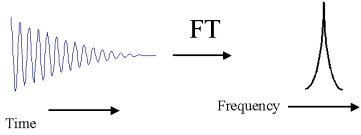
Fourier Transformation function converts time to frequency domain (Image Courtesy : http://chemistry.umeche.maine.edu)
Nuclear Magnetic Resonance helps provide structural details on molecules. It is based on transitions between nuclear spin states of NMR active nuclei by positioning the sample in an external magnetic field. Observations have been made on Continuous wave (CW) and FT – NMR techniques. The benefits of FT – NMR over CW – NMR are discussed in the present article. However, before discussing the benefits it is important to have a clear understanding of the two techniques.
Continuous wave NMR
Continuous wave NMR uses a fixed magnetic field and sweeping of frequency by varying the current in a frequency coil to achieve resonance absorption signals. CW -NMR spectrometer finds routine use for 1H NMR studies at 60 MHz. They are commonly seen in university laboratories as they require low maintenance and operational costs. Such instruments require only water cooled electromagnets unlike the liquid helium cooled high-speed superconducting magnets required for FT – NMR spectrometers.
Fourier transform NMR (FT – NMR)
The Fourier transform technique offers similar advantages as in case of FT – IR. The nuclei in the magnetic field are exposed to short duration (around 10 µs) pulses of radiofrequency radiation. The pulse duration is sufficient to excite all the NMR active nuclei present. The delay between successive pulses permits all excited nuclei to relax back to their ground states. The relaxation is referred to as free induction decay. The free induction decay is detected with the RF coil which is perpendicular to the static magnetic field. Such signals are digitized and added from numerous successive pulses over a period of time to improve the signal-to-noise ratio. Using the Fourier transform function the free induction delay response is converted from time domain to the frequency domain resulting in recording of spectrum similar to the CW spectra.
Benefits of FT – NMR
Time-saving
NMR active nuclei present in the molecule are scanned simultaneously and this results in greater useful structural information from samples containing nuclei other than 1H.
Higher sensitivity
Co-addition of spectral response over a given time period improves signal-to-noise ratios and this leads to improved sensitivity. Unlike CW – NMR which is used primarily for 1H studies NMR information on other nuclei like 13 C, 31 P and 19 F give poor response due to their lower isotopic abundance. FT- NMR affords greater sensitivity for studies on such nuclei due to signal averaging. Remarkable increase in sensitivity often results in useful information from the limited available sample amounts.
FT- NMR instruments though expensive to operate and maintain yield a wealth of information which was not possible with CW instruments. Today most manufacturers have discontinued manufacture of CW instruments.
What are the main advantages of FT-NMR over continuous wave NMR?
Fourier transform NMR (FT-NMR) saves time by exciting all NMR-active nuclei simultaneously with short radiofrequency pulses, and it offers much higher sensitivity through signal averaging, making it far more effective than continuous wave NMR for studying nuclei with low isotopic abundance, such as carbon-13, phosphorus-31, and fluorine-19.
Why is FT-NMR more sensitive than CW-NMR?
FT-NMR co-adds the spectral response from many successive pulses over time, which improves the signal-to-noise ratio and reveals useful information even from limited sample amounts, whereas CW-NMR sweeps frequency slowly and lacks this signal-averaging advantage.
What equipment does CW-NMR require compared with FT-NMR?
CW-NMR spectrometers require only water-cooled electromagnets, giving them low maintenance and operating costs, while FT-NMR spectrometers require liquid-helium-cooled, high-speed superconducting magnets, making them more expensive to operate and maintain.
Are continuous wave NMR instruments still manufactured?
No. Most manufacturers have discontinued production of continuous wave NMR instruments because Fourier transform NMR provides substantially more structural information and sensitivity for essentially all common applications.
What does the Fourier transform do in FT-NMR?
The Fourier transform converts the time-domain free induction decay signal captured after each radiofrequency pulse into the frequency-domain spectrum familiar from continuous wave NMR, allowing the same type of spectral information to be obtained far more quickly and sensitively.