
Applications of UV – VIS Spectroscopy
UV-Vis spectroscopy is an analytical technique that measures the absorption of ultraviolet and visible light, roughly 180 to 800 nm, by a sample’s electronic transitions, with applications spanning reaction monitoring, purity checking, quantitative determination of organic, inorganic, and biochemical species, and HPLC detection.
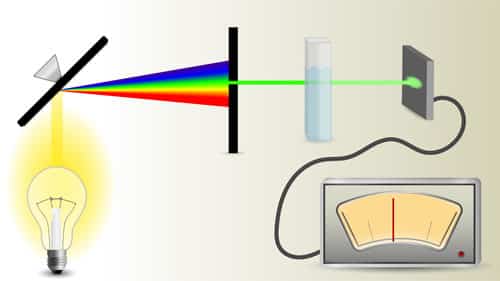
UV—VIS-Spectrophotometer-schematic
UV – VIS Spectroscopy exploits the absorption of light in the UV and visible regions of the electromagnetic spectrum by chemical absorbing species. The region covered falls between 180 nm – 800 nm though some instrument manufacturers provide absorption range extending up to 1100 nm.
UV-VIS Spectroscopy provides a simple and fast technique for qualitative and quantitative estimations covering a large number of application areas.
Absorption in UV- visible region arises due to transitions between the electronic energy levels of absorbing molecules. A typical spectrum comprises of a plot of absorption versus wavelength. Common absorbing spices are organic molecules, inorganic ions of transition metals and charge transfer complexes. A large number of organic, inorganic and biochemical molecules can be determined with a good degree of accuracy at 10⁻⁴ to 10⁻⁵ M concentration levels or even lower. In addition UV-VIS spectroscopy provides structural information such as presence of unsaturation in the molecule.
General Applications
Solids are seldom studied directly due to random refraction and reflection losses on the surface. Such solids can be dissolved in suitable solvents transparent in the absorption region of interest. The solutions can be studied in transparent cells or cuvettes made of quartz or glass. Gases can also be studied in such cells provided with gas tight stoppers.
Some common applications of UV – VIS spectroscopy are briefly listed here:
- The absorption of a reactant or product at constant wavelength provides a means of monitoring the progress of a chemical reaction. Clinical studies using indirect measurement of reaction is characterized by enzymes can also be carried out.
- DNA or Deoxyribonucleic acids are involved in protein synthesis in living cells and preserve genetic information. Changes in pH or heating can lead to denaturation with the resultant increase in absorption at 260 nm. Monitoring absorption at this wavelength is useful for denaturation monitoring.
- Appearance of additional peaks due to presence of impurities can help establish purity of standard materials
- Absence or presence of functional groups results in absence of presence of their characteristic absorption bands
- Identification and quantitative determination of polynuclear aromatic compounds
- Non – absorbing molecules can be estimated by combination with derivative forming molecules that produce new spices with absorption characteristics in the UV – VIS region
- Quantitative estimation of ionic solutions of transition metals or complex forming ligands
- Versatility of UV-VIS spectroscopy has been adapted to detection in HPLC technique. It is the most popular detection mode in HPLC for organic molecules.
The scope of applications of UV - VIS spectroscopy is fast expanding and new applications are daily reported. The simplicity, accuracy and cost effectiveness contribute to its popularity in areas such as pharmaceuticals, life sciences, foods, environmental studies, forensics and mineralogy Today it is difficult to imagine a laboratory that is not equipped with a UV- Visible spectrophotometer.