
Benefits of Microwave Digestion over Open Acid Digestions
Microwave digestion is a closed-vessel sample preparation method that dissolves solid matrices, such as body tissue, soils, or minerals, into liquid form for trace metal analysis by Atomic Absorption Spectroscopy or ICP, completing digestions in under an hour under controlled temperature and pressure compared with the 5 to 12 hours or more typically needed for open acid digestion.
Trace metal analysis by Atomic Absorption Spectroscopy or ICP requires that the sample be in liquid state before introducing into the system. At times samples come in liquid form such as drinking water, beverages, liquor which require little or no sample treatment prior to analysis. However, samples can also be complex matrices such as body tissue, hair, blood, fats & oils, minerals, rocks, soils, ceramics, oxides, coal, etc. such samples are extracted using acid digestions for removal of metals prior to analysis.
The objective is to achieve complete decomposition of the solid matrix while preventing loss or contamination of the analytes.
Wet chemical digestions utilize various mineral acids such as HNO3, HCL, HF, H2SO4, HClO4 or combinations of such acids. Digestions can be carried out in either open system under atmospheric pressure or under elevated temperature using microwave digestions.
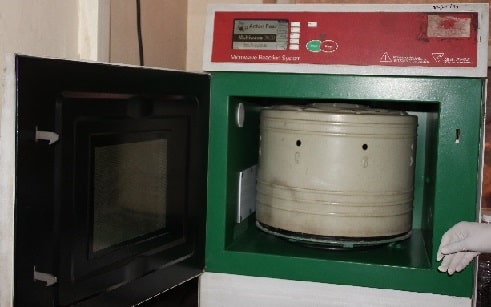
Microwave Digestion System
Conventional open wet sample digestions of solid samples are carried out in vessels containing the sample and large volume of acids. The mixture is heated inside a fume hood for long periods using hot plate or a heating mantle. The heating is stopped when the analyst feels that digestion is complete. In contrast microwave digestion offers digestions of both inorganic and organic matrices under controlled conditions.
Microwave digestion systems offer several distinct advantages over open digestions:
- Biggest benefit is time saving. Simultaneous heating of 8 – 12 samples is possible and reaction times are typically less than an hour in comparison to 5 – 12 hours or even more for open digestions.
- Time taken for a digestion is dependent on temperature.Open digestions are limited to boiling points of acids used whereas closed digestion systems can be operated at higher temperatures of 250 – 300OC due to ability to withstand higher pressure.
- Acid consumption is lower in microwave digestion
- Microwave digestion systems offer greater extraction efficiency whereas in open system digestion extraction can be incomplete depending on discretion of the analyst.
- No exposure of analyst to corrosive acid fumes as compared open digestions
- Loss of volatile elements such as Hg or Pb can take place in open digestion whereas in closed system digestions loss of volatile elements is prevented.
- A greater risk of contamination from external sources exists in open digestion whereas in closed systems the risk is non-existent
Closed microwave digestion systems have only one disadvantage, namely, explosion and cracking of digestion tubes due to simultaneous build - up of pressure alongwith increase of temperature. However, microwave systems have inbuilt sensors for both temperature and pressure. The microwave power is automatically controlled or shut-off when pressure reaches the maximum limit.
Microwave closed system advantages far outweigh the disadvantage and is therefore a very useful addition to high throughput laboratories.
Please share your experiences of handling difficult digestions and leave your comments.