
IR spectroscopic analysis
Cell materials are generally used in the form of rectangular cavities or parallel plates for holding the sample in the beam path of the spectrometer.
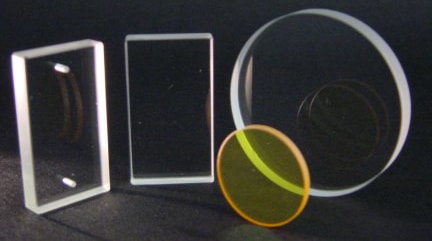
IR Transmission material windows (Image Courtesy : http://www.lab-club.de/)
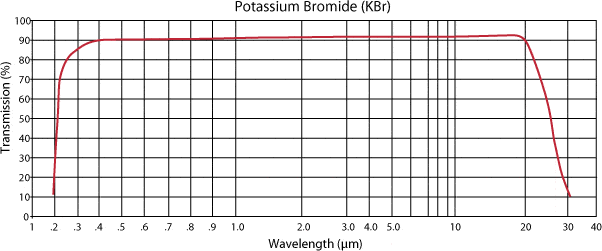
KBr Transmission Spectrum (Image Courtesy : http://www.edmundoptics.com/)
The desirable characteristics of cell materials are:
- Inertness towards the sample
- High transmission in the wavelength range to be scanned
- Should be available in pure state that is suitable for spectroscopic studies
- Should be safe to handle ,i.e, non-toxic
- Should have low refractive index in the wavelength region of interest so that reflection loss is minimal and there are few interference fringes
- Should not be hygroscopic as this can lead to fogging of windows
- Should not be too hard or too soft for convenience of polishing
Glass is a common window material in the visible region because of its transparency. However, it is not suitable for IR region because it strongly absorbs IR radiation. Quartz which is suitable in UV region is not of much use in IR studies. In some cases infrared quality quartz with low hydroxyl group content can be used.
Measurements of liquid samples in IR spectral region are generally carried out in either fixed or variable path length cells. Use of demountable cells is recommended as they can be easily dismantled for cleaning and the liquid film thickness can be controlled by using variable thickness teflon spacers.
A reference chart on properties of commonly used materials is provided to help you select the appropriate material for your application.
| Material | Transmission Range (cm⁻1⁾ | Window Cleaning Solvents | Comments | | --- | --- | --- | --- | | AgCl | 25000-360 | Acetone, Methylene Chloride | Soft crystalline material, insoluble in water. Darkens on exposure to UV light | | BaF₂ | 67000-740 | Acetone, Alcohol | Should not be used for ammonium salts | | Cadmium Telluride (CdTe) | 20000-400 | Acetone, Alcohol | Attacked by oxidizers and acids | | CsI | 40000-200 | | Soft and highly hygroscopic. Difficult to polish | | KBr | 40000-400 | Anhydrous Alcohols | Most commonly used in mid - IR region. Easy to polish but should be preserved in moisture free environment | | Thallium Bromide Iodide (KRS-5) | 20000-250 | Methyl Ethyl Ketone | Highly toxic. Attacked by acids and bases | | NaCl | 40000-625 | Anhydrous solvents | Hygroscopic but less hygroscopic than KBr. Lower cost than KBr | | Zinc Sulfide (Irtran-2) | 17000-700 | Alcohol, Acetone | Insoluble in water but attacked by acids | | Zinc Selenide (Irtran-1) | 20000-450 | Alcohol, Acetone, Water | Insoluble in water but soluble in acids and strong alkalies |