
Comparison between Single Beam and Double Beam Atomic Absorption Spectrometer Systems
Single-beam and double-beam atomic absorption spectrometers are two optical configurations for measuring an element’s light absorption; single-beam designs pass light through only the sample, while double-beam designs split the beam between sample and reference paths to compensate for lamp drift and electronic fluctuations.
A spectrometer is one of the types of devices used for measuring electromagnetic radiation wavelengths, given they interact with a sample. A spectrophotometer, on the other hand, is a subcategory of spectrometer devices, which focus on the measurement of the light’s wavelength distribution. Therefore, it can be used for various purposes like UV – Visible, Infrared, Raman, Atomic Absorption Spectroscopy, etc.
Color detection is the primary use of a spectrophotometer where it takes a reference and provides the percentage of transmittance or reflectance from an object. Usually, a perfect Reflecting Diffuser is kept as a reference for this purpose.
Here, we will be discussing the concept, along with its two major types: single beam spectrophotometer and double beam spectrophotometer.
Different Types of Spectrophotometers
The Design of spectroscopic systems is based on the fundamental principle of light absorption by absorbing species-the Beer Lambert law. Over the years basic design has been based on single beam or double beam optics with the latter gaining prominence due to its distinct advantages.
Advances in electronics and detection systems have contributed further to the popularity of double beam systems. In the present article the discussion will be limited to Atomic Absorption Spectroscopy systems.
It is important to understand the optical layout of both single beam and double beam systems before you begin to appreciate the advantages of one over the other. So let’s get into the details and know these systems better.
Understanding Single Beam Spectrophotometer

Single Beam Schematic Diagram
This spectrophotometer is used to measure the relative intensity of light before and after inserting a test sample. It functions by either blanking the instrument or standardizing it with respect to the reference. There are four basic single beam spectrophotometer components:
- Monochromator
- Detector
- Light source (should be stable over time, low cost, wide wavelength range brightness, and long service life)
- Sample (object)
You can understand more about it from its working.
Working: The light source comprising of a hollow cathode lamp emits sharp atomic line of the element whose determination is required. The light is modulated (switched on and off) rapidly by means of a rotating chopper located between the light source and the flame.
Modulation can also be achieved by pulsing the power (switched on and off rapidly) to the light source. Modulation serves to differentiate the light coming from the source lamp from the emission from the flame.
The modulated light is led to the flame where ground state atoms of the element of interest are present and after absorption is led to the monochromator which isolates the wavelength of interest which is then led to the detector.
Now that you know what a single beam spectrophotometer is and how it works, let’s see some of the advantages and disadvantages of this instrument.
Advantages of a Single Beam Spectrophotometer
- Cost-Effective: Single beam instruments are less expensive as compared to the other alternative.
- Better Performance: High energy throughput due to the non-splitting of the source beam results in high sensitivity of detection.
Disadvantages of a Single Beam Spectrophotometer
- Instability: This happens due to lack of compensation for disturbances like electronic circuit fluctuations, voltage fluctuations, mechanical component’s instability, or drift in the energy of light sources. Such drifts cause abnormal fluctuations in the results.
Understanding Double Beam Spectrophotometer
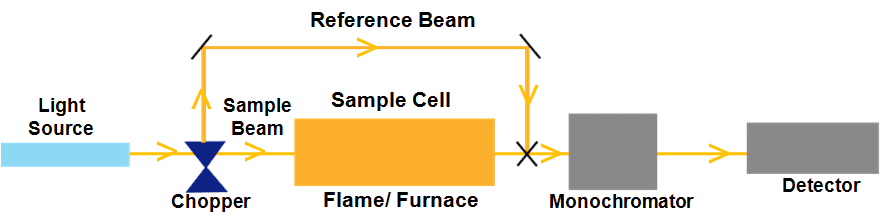
Double Beam AAS Schematic Diagram
Unlike the single beam variant, this one does not standardize or blank the instrument before use. Instead, it splits the beam into two parts for the same purpose. One of the beam parts is passed through the given object while the other passes through a reference standard. The number of components also get increased in this spectrophotometer.
- Sample Holder
- Interpreter
- Light Source
- Detector
- Monochromator
Let’s see the working of this spectrophotometer.
Working: The light beam from the source is split into sample beam and reference beam by the mechanical chopper. The reference beam monitors the lamp energy whereas the sample beam reflects sample absorption.
The observed absorbance measurement is the ratio of the sample and reference beams which are recombined before moving to the monochromator. This arrangement compensates the effects due to drift in lamp intensity, electronic and mechanical fluctuations which affect both the sample and reference beams equally.
Now let’s see what the advantages of using a double beam spectrophotometer are.
Advantages of a Double Beam Spectrophotometer
- More Reliable Detection: Modern improvements in optics permit a high level of automation and offer the same or even better level of detection as compared to earlier single beam systems. Instability factors due to lamp drift, stray light, voltage fluctuations do not affect the measurement in real-time.
- No Warm-Up Time: Little or no lamp warm-up time is required. This not only improves the throughput of results but also conserves lamp life.
Single vs. Double Beam Spectrophotometer: Which One to Pick?
As per the advantages, we can say that double beam spectrophotometers would be more beneficial. But you must consider the following points before selecting one.
- Cost: Obviously, a more significant price will be associated with the more complex structured instrument. So you will have to add more funds into your spectrophotometer budget if you want to go for the more advanced option. However, you can consider spending a little extra because of all the benefits that the double beam alternative is offering. Plus, the overall cost gets reduced in it due to the conservation of lamp life.
- Hassle: If you want to keep your work faster, you need to go for the double beam spectrophotometer. It passes the light from reference and the sample at the same time. Therefore, you don’t have to go through any hassle. On the other hand, the single beam option requires you to put in the reference first, then standardize the instrument according to it, and then remove it to place in the sample finally. Opt for this alternative only if you have the energy and time to do all the excess work.
Although both options work fine, a double beam spectrophotometer does have a few benefits over a single beam.
Your choice majorly depends on your priorities. If you want to keep the price low and can work with little instability and hassle, you can go with a single UV beam spectrophotometer. But in case you want overall better performance, you will have to opt for the double beam alternative.
The topic is open for discussion and you may offer your valued comments.
What is the difference between a single beam and double beam spectrophotometer?
A single beam spectrophotometer measures light intensity before and after a sample is inserted, requiring the instrument to be blanked or standardized against a reference first, while a double beam spectrophotometer splits the light into two beams, one through the sample and one through a reference, measured simultaneously.
Which is more cost-effective, single beam or double beam?
Single beam spectrophotometers are more cost-effective than double beam instruments because their simpler optical design, without a beam-splitting mechanism, requires fewer components.
Why is a double beam spectrophotometer considered more stable?
A double beam design compensates for fluctuations in lamp intensity and electronic or mechanical drift because both the sample and reference beams are affected equally and simultaneously, cancelling out those disturbances in the measurement, an advantage single beam instruments lack.
Does a double beam spectrophotometer require lamp warm-up time?
No, or very little. Double beam spectrophotometers require little to no lamp warm-up time, which improves throughput and conserves lamp life compared with single beam systems.
Which type of spectrophotometer should I choose for my lab?
The choice depends on your priorities: a single beam spectrophotometer is a lower-cost option suitable if you can tolerate some instability and manual standardization steps, while a double beam spectrophotometer offers better overall performance and convenience at a higher price point.