
Graphite Furnace Atomization in Atomic Absorption Spectroscopic Analysis
Flame atomization and graphite furnace atomization are the two techniques used to convert a sample’s element of interest into ground-state atoms for Atomic Absorption Spectroscopy; flame atomization gives fast, moderate-cost analysis at ppm-to-ppb detection limits, while electrothermal graphite furnace atomization uses a heated graphite tube to reach lower, sub-ppb detection limits from much smaller sample volumes.
Atomic Absorption Spectroscopy has matured into a well accepted technique for analysis of trace metals in numerous application areas. It is routinely used for determination in parts per million to parts per billion concentration ranges with speed and affordable cost.
The two main techniques employed for sample atomization are flame atomization and electrothermal graphite furnace atomization. The benefits and limitations of the two atomisation processes were outlined in an earlier article Graphite Furnace Atomic Absorption Spectroscopy. The objective of the present article is to define the differences.
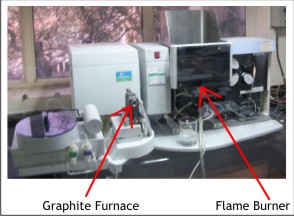
Mdern AAS with Flame & Graphite Furnace Operation
Flame Atomization
Flame atomization uses an air-acetylene or nitrous oxide – acetylene flame to remove the solvent and bring the element in the sample to ground state The ground state atoms absorb light from the hollow cathode lamp and produce signal proportional to the concentration of atoms in the light path.
Graphite Furnace Atomization
The technique is similar to flame atomization except that the flame is replaced by an electrically heated closed graphite tube having transparent end windows. The tube generates a cloud of atoms which is exposed to the light from the hollow cathode lamp. The higher the atom density and longer the residence time in the tube the lower will be the detection limit.
The benefits and limitations of the two atomization techniques are provided as tabulated data for ready reference.
| | Flame AAS | Graphite Furnace AAS | | --- | --- | --- | | Capital Cost | Moderate | Higher | | Operational Cost | Low | Medium | | Sample Throughput | 15-20 sec per element | 3-4 minutes per element | | Detection Limit | ppm - ppb levels | sub ppb levels | | Tolerance for dissolved solids | 0.5 - 3 % | ~ 20% (Slurries) | | No. of elements | ~ 70 | ~ 50 | | Sample requirement | Large (few ml) | Small (few µl liters) | | Unattended Operation | No | Yes | | **Interference :**SpectralChemical (Matrix) Physical (Matrix) | Very FewMany Some | Very FewMany Very Few |
An analysis of the tabulated comparison above shows that you have to select the atomization technique on the basis of considerations such as cost, sample throughput, required detection limits, etc. However fortunately most manufacturer’s today are providing Atomic Absorption systems with convenient interchangeable atomization options.
Please share your opinion and offer your comments.