
Gas Liquid Chromatography
Gas-solid chromatography (GSC) and gas-liquid chromatography (GLC) are the two forms of gas chromatography distinguished by their stationary phase: GSC separates compounds on an active solid adsorbent packed in the column, while GLC, synonymous with conventional GC, separates them on a thin nonvolatile liquid film coated onto an inert support or capillary wall.
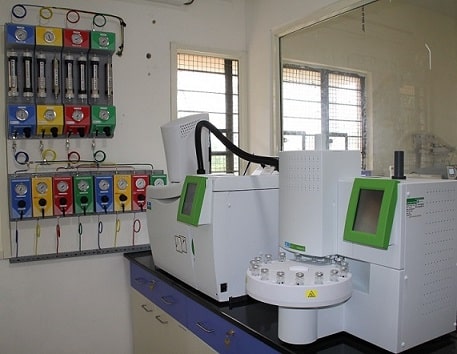
Gas Chromatograph
Gas chromatography is a versatile technique used for separation and identification of volatile compounds of liquid mixtures and gases. The distinction between Gas Solid chromatography (GSC) and Gas Liquid chromatography (GLC) is often not clearly understood. The objective of this article is to clarify the differences between the two techniques.
The basic principle of gas chromatography separations is resolution of the sample constituents by partitioning them between the mobile gas phase and the stationary phase inside the GC column. Based on physico-chemical interactions the compounds are retained selectively inside the column and get eluted sequentially over a period of time depending on the operating conditions.
Gas Solid Chromatography
The stationary phase comprising of an active solid adsorbent powder is filled in an open tube. The active solid support provides an adsorbent surface on which selective adsorption and desorption of the volatile components takes place. Generally the packed columns are up to 10 m in length with internal diameters ranging from 2-4mm..
Conventionally columns are packed with porous polymers or materials such as activated carbon, molecular sieves, silica and alumina powder, etc.
Gas Liquid Chromatography
Gas Liquid chromatography is often synonymously referred to as Gas chromatography (GC). In this technique a nonvolatile liquid is coated as a thin layer on a powdered inactive solid support or on the inside wall of the capillary tubing. The thin liquid film serves to partition the sample components between the liquid film and the carrier gas. The inert support serves to increase the surface area of the liquid film for greater interaction with sample components.
In open tubular chromatography there is no packing inside the tube but the walls of the tube are coated with a thin layer of the liquid or the wall is coated with the inert solid support bearing the liquid film. It is possible to achieve better resolution and shorter run times and lower concentrations in comparison to packed columns.
Capillary columns range in length from about 30 m of 100 meters with internal diameters from about 0.1 mm - 0.53 mm.
The solid supports used include materials such as diatomaceous earths, crushed firebricks, glass powder, powdered teflon, carbon black,etc. Liquid phases applied generally have low volatility and high decomposition temperatures. Some typical examples are dimethyl silicone, polyethylene glycol, diethylene glycol succinate (DEGS), 50% phenyl methyl silicone, etc.
GLC has several advantages over GSC:
- Wide range of liquid coatings afford a large range of separations
- Afford large concentration ranges to be evaluated
- Good resolution between peaks in shorter analysis time.
However, GSC can be used at higher temperatures due to limitations of volatility and instability of liquid coatings at higher temperatures. GSC is more often used for analysis of gases having no active functional groups which interact with the adsorbent surface.
What is the difference between gas-solid and gas-liquid chromatography?
Gas-solid chromatography (GSC) separates compounds using an active solid adsorbent as the stationary phase, while gas-liquid chromatography (GLC), the technique most people simply call gas chromatography (GC), separates compounds using a thin nonvolatile liquid film coated on an inert support or capillary wall.
What are the advantages of GLC over GSC?
Gas-liquid chromatography offers a wider range of liquid coatings for different types of separations, can evaluate larger concentration ranges, and typically achieves better peak resolution in a shorter analysis time than gas-solid chromatography.
When is gas-solid chromatography preferred over gas-liquid chromatography?
Gas-solid chromatography is preferred at higher analysis temperatures, since it avoids the volatility and thermal instability limitations of the liquid coatings used in gas-liquid chromatography, and it suits gases that have no active functional groups to interact with the adsorbent surface.
What materials are used as the stationary phase in gas-solid chromatography?
Gas-solid chromatography columns are typically packed with porous polymers or active adsorbent materials such as activated carbon, molecular sieves, silica, and alumina powder.
What is the typical column length for gas-solid versus gas-liquid chromatography?
Packed gas-solid chromatography columns are generally up to about 10 meters long with internal diameters of 2 to 4 millimeters, while gas-liquid (capillary) chromatography columns typically range from about 30 to 100 meters in length with much narrower internal diameters of 0.1 to 0.53 millimeters.