
How are Colorimeter, Photometer, Spectrometer and Spectrophotometer different from each other?
During your university years you would have heard about spectroscopic devices. The terms are often used synonymously but let us accept that such terminology is confusing to most of us. The objective of this article is to clarify the differences between such spectroscopic devices.
Colorimeter
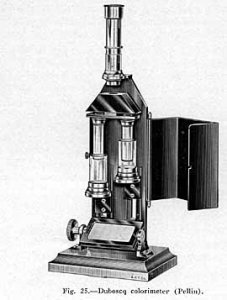
Duboscq Colorimeter (Image Courtesy : http://physicsmuseum.uq.edu.au/)
Colorimetry, one of the earliest of spectroscopic techniques, was based on comparison between colour produced by an unknown amount of a substance with the same colour produced by a known amount of the same substance.
The colour of the test solution in a Nessler tube diluted to a fixed volume is compared with the series of standards of the same component prepared under matching conditions. The colour matching to the prepared standards approximates the concentration of the unknown.
In another version called the do Duboscq method the vertical height of liquid in the unknown sample tube is adjusted so that on vertical observation the intensities of the colour are the same. The concentration of the unknown is calculated by the relation
C_unknown X H_unknown = C_standard X H_standard
where C_unknown is the unknown concentration
H_unknown is the unknown solution column height
C_standard is the standard solution concentration
H_standard is the standard solution column height
In another version called Lovibond comparator coloured standard glass filters are matched with the colour of unknown solution to arrive at the unknown concentration
Colour characters were based on individual visual matching of colours and were prone to personal errors.
Photometer
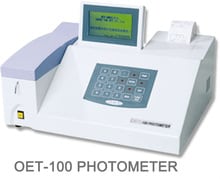
Filter Photometer (Image Courtesy : http://i00.i.aliimg.com/)
Photometers began replacing the visual eye colour matching colorimeters with the photo electric cell. A photometer comprises of a light source, a light filter for isolation of a range of wavelengths, sample holder cell, photoelectric detector and lastly a recording device.The current response of the photoelectric cell is dependent on the light reaching the cell.
The required spectral bandwidth is isolated by making use of coloured glasses or coloured gelatin glass filters. Such filters have been used in both colorimeters and photometers. These filters were effective in isolating a band of wavelengths rather than a single wavelength and also tend to deteriorate during use due to fading .
Spectrometer
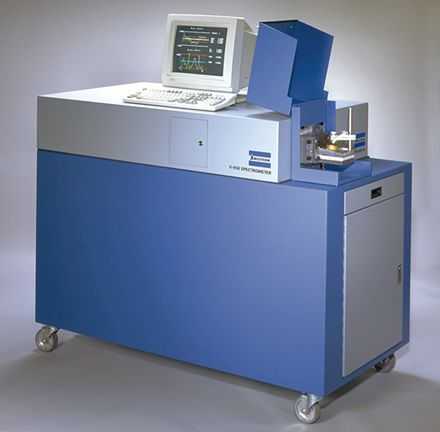
Arc Spark Spectrometer (Image Courtesy : http://image.made-in-china.com/)
You would have come across the term spectroscope or spectrograph. Both these terms refer to a common device designed to record the wavelength of light after it has interacted with the sample using a graduated wavelength scale. Spectrometers have widespread use in determination of elemental composition of alloys without sample preparation through application of an electric arc discharge and observation of wavelengths of emitted radiation.
Spectrophotometer
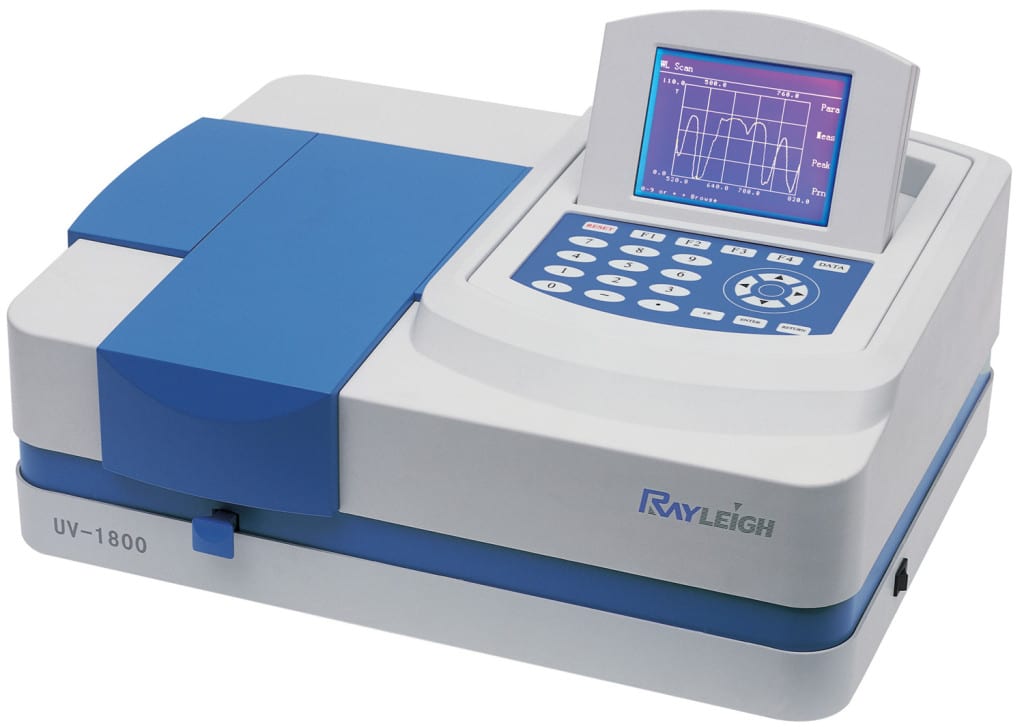
Spectrophotometer (Image Courtesy : http://en.bfrl.com.cn/)
As its name suggests a spectrophotometer is a combination of a spectrometer and a photometer as its name suggests. It makes use of a sophisticated wavelength isolation device called a monochromator. A monochromator makes use of a prism or a grating-based wavelength isolation arrangement which makes isolation of a single wavelength or a narrow band of wavelengths. Instead of measuring wavelength light intensity is measured in case of spectrophotometer. Detection of light is based on the same principle as in case of a photometer.
Spectrometers find use mainly in the visible region of electromagnetic radiation whereas spectrophotometers are universally used in a broad wavelength range from UV to visible to infrared. Applications provide solutions in both identification and quantification of inorganic compounds as well as organic and complex biochemical molecules.