
Multi Element Hollow Cathode Lamps – How they compare with Single Element Hollow Cathode Lamps?
A multi-element hollow cathode lamp is a light source for Atomic Absorption Spectroscopy whose cathode is fabricated from a combination of two to seven different elements, allowing each element to be determined sequentially from a single lamp instead of requiring a separate single-element hollow cathode lamp for every analyte.
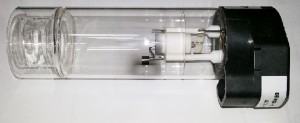
Multi Element Lamp (Longitudinal View)
The light source used in Atomic Absorption Spectroscopy is unique. It looks like any other lamp but its uniqueness lies in the fact that its cathode is made of the same element which you have to determine in your sample. This means that you have to use a different lamp for every element whose analysis is required.
Light sources in Atomic Absorption Spectroscopy briefly provides introduction to hollow cathode lamps and multi element hollow cathode lamps. Use of multi element lamps offers several benefits to the user in terms of time and cost:
- Multi element lamps are available in combinations of 2-7 different elements
- Cost savings as different hollow cathode lamps need not be purchased for each element to be analyzed
- Higher sample throughput can be achieved as there is no need for initial warm up for separate lamps
- Elements present in multi element lamps can be determined sequentially using same lamp without need for changing different lamps
- Hollow cathode lamps have a shelf life and even if not used cannot be stored indefinitely. Use of multi element lamps does not require purchase and storage of different constituent element lamps
Important features of multi element hollow cathode lamps of Atomic Absorption Spectroscopy
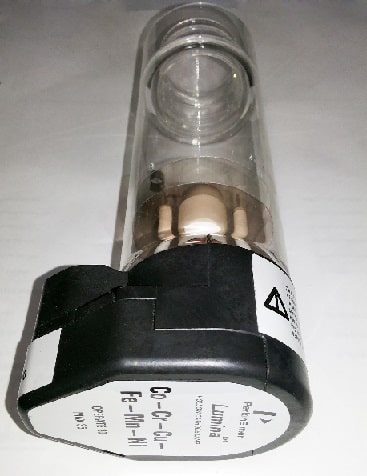
Multi Element Lamp (End View)
Important operational features from manufacturer point of view are discussed below:
- The essential feature of a hollow cathode lamp is to generate a narrow emission line of the element which is to be tested. The same is true for a multi element hollow cathode lamp. It should give narrow emission line of the constituent elements. Such lines should be well resolved to be free of interferences and also have sufficient intensity
- The multi element lamp should be commercially viable in terms of user applications. The element combinations should be able to cater to the needs of different market segments such as environmental, drinking water, ornaments and base metal analysis.
- The metals should be compatible with one another and form homogeneous alloys.
- It should be possible to guarantee a lifetime for lamp usage. Single element lamps are normally guaranteed for 5000 milliampere-hours. The guaranteed lifetime of multi element lamp should not be comparable and not far too less.
- Choice of elements and their relative proportions need to be carefully evaluated to get optimum usage features
Though economical it is commonly believed that multi element lamps compromise on sensitivity as the analytical line intensities are lower than single element lamps and though not significant there can be interference due to presence of other elements. Some manufacturers have overcome such problems by using boosted discharge lamps which enhance the analytical lines of the constituent elements.
Please do share your experiences on use of multi element hollow cathode lamps and leave your comments.