
Spectroscopic Analysis
Spectroscopic analysis based on nuclear energy levels covers analytical techniques, such as NMR and Mossbauer spectroscopy, that excite atomic nuclei with external radiant energy to reveal the structural arrangement of atoms and functional groups within molecules.
Optical spectroscopic methods of analysis are based inherently upon interaction of electromagnetic radiant energy with electrons surrounding the nucleus. Such techniques provide information which is useful for both qualitative and quantitative estimations and arrangement of atoms in crystalline materials such as in X-ray diffraction studies.
The present article discusses two important analytical spectroscopic techniques which are based upon excitation of nuclei by external sources of radiant energy. The two techniques are NMR spectroscopy and Mossbauer spectroscopy which provide the spectroscopist with a wealth of information on the structural arrangement of atoms and functional groups in molecules.
NMR spectroscopy
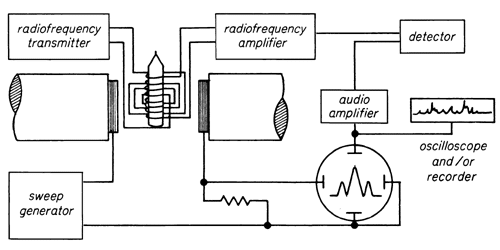
NMR Spectrometer Schematic Diagram
NMR offers solutions for identification and structure elucidation of complex organic molecules, multicomponent mixtures, organometallics and biomolecules.
Nuclei having odd value for the sum of protons and neutrons are important for NMR studies such as ¹H, ¹⁵ N, ¹⁹F, ³¹P, ¹³C and ¹⁷O. Carbon – 13NMR has been found to be useful specially for structure elucidation studies.
The unique advantage offered by NMR spectroscopy is that a pure compound in varying concentrations is not necessary for calibration purpose. There exists a direct relation between area of peak and the number of nuclei responsible for that peak. The peak of the internal standard should not overlap with any of the sample peaks. Silicon compounds are unique because of greater separation of the proton peaks.
FT – NMR is of great benefit when limited amounts of sample are available. It enables distinguishing weak signals from background noise. FT – NMR instruments offer high resolution and wavelength reproducibility that is needed for structure elucidations of complex molecules.
Mossbauer spectroscopy
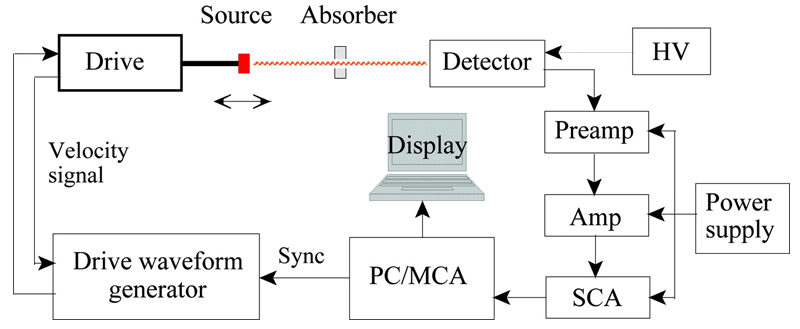
Mossbauer Spectrometer Schematic Diagram
Mossbauer spectroscopy is based on recoil- free, resonant absorption and emission of gamma in solids. It probes minute changes in the energy levels of the nucleus in response to excitation by gamma radiation .High and extreme narrow line widths contribute to the extreme resolution and sensitivity of the technique.
A solid is exposed to a beam of gamma radiation and a detector measures the intensity of the beam transmitted through the sample. The source uses the same nucleus emitting gamma radiation as the nuclei in the sample. The source is accelerated through a range of velocities to produce Doppler effect and scan energy through the required range. The resulting spectra plots gamma ray intensity as a function of source energy which provides information about the chemical environment of the absorbing nuclei in the sample
Mossbauer spectroscopy has found a large number of applications in geological analysis It affords detection of such subtle changes in the chemical environment of the nucleus including oxidation state changes, presence of different ligands and magnetic environment of the sample. Changes in oxidation state of the nucleus induce changes in the chemical environment which is easily monitored as as isomeric shift in the spectrum. Mossbauer spectroscopy finds numerous applications in analysis of extraterrestrial rock specimens including meteorite dust and moon rocks.
The next article will be covering exploitation of process at the nuclear level involving radioactive processes.