
What are the Differences between GC and HPLC ?
Gas chromatography (GC) and high-performance liquid chromatography (HPLC) are separation techniques that differ chiefly in their mobile phase: GC uses a carrier gas to separate volatile, thermally stable compounds at elevated temperature, while HPLC pumps a liquid solvent through a column to separate larger, less volatile, or heat-sensitive compounds at room temperature.
| 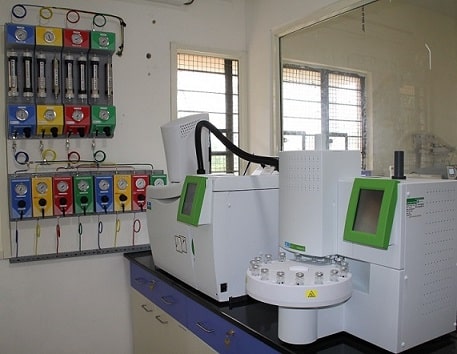
Gas Chromatograph |
| --- |
| 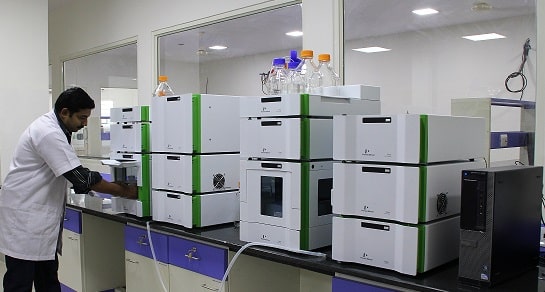
High Performance Liquid Chromatograph |
Gas chromatography and High Performance Liquid Chromatography are both separation techniques which have gained immense popularity in both academic and industrial laboratories. High Performance Liquid Chromatography has found favour in applications covering pharmaceuticals, foods, life sciences and polymers whereas Gas Chromatography has significant applications in petroleum and petrochemical industry, flavours and fragrances and, environmental air monitoring,. A general question that comes up in your mind is how our HPLC and GC are different from each other and what factors decide suitability of one over the other.
Mobile phase
As the name suggests High Performance Liquid Chromatography uses a liquid mobile phase and gas chromatography uses a gas as the carrier. Liquids are generally mixtures of solvents of compatible polarities whereas in gas chromatography the mobile phase is a single high purity gas.
Operating temperature
HPLC separations are mostly carried out at ambient temperatures whereas Gas Chromatography separations are carried out at elevated temperatures which can be held at a constant value (isothermal) or variable as decided by the temperature program. Newer packings have extended temperature limits of High Performance Liquid Chromatography operation as well.
Nature of compounds
Gas chromatography separations are mainly carried out on compounds ranging in molecular weights up to a few hundreds. Such compounds separate on differences in their volatilities and remain stable at high temperatures. On the other hand compounds separated on HPLC have higher molecular weights ranging from a few hundreds to several millions for large polymers and biomolecules. Such compounds can be analysed at room temperature only because at elevated temperatures they tend to degrade.
Column Dimensions
Liquids used as carrier in HPLC generally have higher viscosity in comparison to gases used in Gas Chromatography. This results in increased column back pressures in HPLC. It is for this reason that High Performance Liquid Chromatography columns are much shorter and have wider diameters in comparison to GC columns which can be much longer and narrower. Increased column length improves resolution between closely spaced peaks. As the trend is towards faster analysis columns used for HPLC are as short as 1 cm in length.
Column Packings
Column packings offer greater resistance to flow of liquids in comparison to gases. Gases also have a higher permeability of solid supports than liquids. The retention mode of HPLC columns depends on polarity differences or molecular sizes whereas GC separations are based on differences in volatilities of compounds
Detection principles
HPLC detection is commonly based on nondestructive detection such as UV, RI, photodiode array detectors, conductivity and laser detection. On the other hand Gas Chromatography detection is based largely on destructive principles such as a FID, NPD and FPD. Mass spectrometry detectors common to both LC and GC are destructive in nature.
Cost of operation
HPLC solvents are costly in comparison to gases used for GC analysis. In addition to cost of solvents the maintenance cost of High Performance Liquid Chromatography systems is also higher due to high pressures developed in pumps and columns. GC analysis in comparison is less costly and there is lesser maintenance cost.
Both HPLC and GC are versatile and have contributed to to the ever increasing scope of applications. Tandem techniques such as LC – MS – MS and GC – MS – MS have expanded the limits of detection to new frontiers of detection and automation has also contributed to increased laboratory throughputs.
Please share your experiences and offer your valued comments.
What is the main difference between GC and HPLC?
The main difference is the mobile phase: gas chromatography (GC) uses a high-purity carrier gas to move the sample through the column, while high-performance liquid chromatography (HPLC) uses a liquid solvent mixture pumped through the column under pressure.
Can GC and HPLC analyze the same compounds?
Not generally. GC is best suited to compounds with molecular weights up to a few hundred that are volatile and stable at high temperature, while HPLC handles compounds ranging from a few hundred to several million in molecular weight, including large polymers and biomolecules that would degrade under GC's elevated operating temperatures.
Why are HPLC columns shorter than GC columns?
HPLC uses a liquid mobile phase, which is more viscous than the gases used in GC and creates higher column back-pressure. As a result, HPLC columns are made shorter and wider to manage that pressure, while GC columns can be much longer and narrower since gases flow with far less resistance.
Is GC or HPLC more expensive to operate?
HPLC is generally more expensive to operate than GC. HPLC solvents cost more than the gases used in GC, and the higher pressures generated in HPLC pumps and columns also increase maintenance costs compared with GC systems.
What types of detectors are used in GC versus HPLC?
GC commonly uses destructive detectors such as flame ionization (FID), nitrogen-phosphorus (NPD), and flame photometric (FPD) detectors, while HPLC typically relies on nondestructive detectors such as UV, refractive index, photodiode array, and conductivity detectors. Mass spectrometry detectors, which are destructive, are used with both techniques.