
Benefit of using Blazed Gratings in AAS Spectrometers
A grating is an optical element in a monochromator that disperses a broadband light beam into distinct wavelengths, with the desired wavelength selected by adjusting the exit slit width; a blazed grating is cut at a specific angle so it concentrates diffracted energy in a chosen wavelength region, giving higher detection sensitivity in AAS analysis.

Example of Light Dispersion
A grating is an optical element in a monochromator that disperses the broadband light beam into distinct wavelengths. The desired wavelength is selected by adjusting the exit slit width of the monochromator.
The angle of dispersion of the grating depends on the number of lines on the grating. Larger the number of lines (usually 1200 lines/mm to 1800 lines/mm) the larger is the dispersion power of the grating. In turn the overall efficiency of the monochromator depends on the dispersing power of a grating.
Mechanical rulings of gratings are in the form of V– shaped grooves. Interference phenomena results in divergence of different wavelengths from the grating at different angles. At the blaze angle the particular wavelength diverges from the surface at an angle corresponding to specular reflectance which means angle of incidence is equal to angle of reflectance and there is least loss in intensity as a result of diffraction. A grating can be made by controlling the angle of cut during the ruling process. The further removed a given wavelength is from the wavelength for which a grating is blazed, the greater will be the extent of light loss at that wavelength. In other words the sensitivity of detection of a particular atomic line is highest at the blaze angle and decreases gradually on either side
Atomic Absorption lines are spread from about 190nm to about 850 nm so a grating blazed somewhere in the middle region is sufficient as energy gradually falls on either side but there is a significant drop at the extremities.
Earlier instruments were equipped with two gratings, one blazed in the UV region and other blazed in the visible region. One had the option to select the grating close to the selected wavelength. Nowadays a single dual blazed grating serves the same purpose without the need for change of gratings during analysis. It has two blaze angles in the two spectral regions.
| 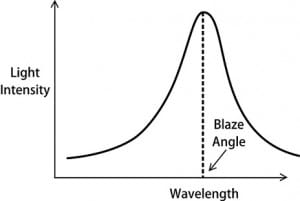
Single Blaze Grating | 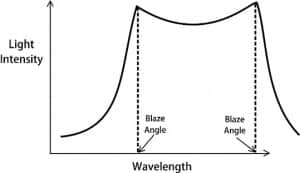
Dual Blazed Grating | | --- | --- |
It can be observed that though maxima appear at the two selected wavelengths the overall dispersed energy sensitivity is greater over the entire wavelength range in comparison to single blazed grating which contributes to greater signal intensity over the complete wavelength range. Thus blazed gratings provide higher detection sensitivities in AAS analysis.
Please share your views and leave your comments on the article.
What is a grating and what role does it play in an AAS spectrometer?
A grating is an optical element in a monochromator that disperses the broadband light beam into distinct wavelengths, with the desired wavelength then selected by adjusting the exit slit width.
How does the number of lines on a grating affect its performance?
The angle of dispersion depends on the number of lines on the grating, typically 1200 to 1800 lines per mm, and a larger number of lines produces greater dispersion power, which in turn improves the overall efficiency of the monochromator.
What is the blaze angle and why does it matter?
At the blaze angle a particular wavelength diverges from the grating surface at an angle of specular reflectance, meaning the angle of incidence equals the angle of reflectance, resulting in the least intensity loss from diffraction and the highest detection sensitivity at that wavelength.
What wavelength range do atomic absorption lines typically cover?
Atomic absorption lines are spread from about 190 nm to about 850 nm, so a single grating blazed somewhere in the middle region is generally sufficient, though sensitivity drops significantly toward the extremities.
How did earlier AAS instruments handle the full wavelength range before dual-blazed gratings?
Earlier instruments used two separate gratings, one blazed in the UV region and one blazed in the visible region, and the operator selected whichever grating was closest to the wavelength being measured.
What is the benefit of a dual-blazed grating over a single-blazed grating?
A dual-blazed grating has two blaze angles in the two spectral regions, and although its maxima appear at two selected wavelengths, its overall dispersed energy sensitivity is greater across the entire wavelength range, giving higher detection sensitivity than a single blazed grating.