
What is the right quality of water for HPLC analysis?
HPLC grade water is ultra-pure water, equivalent to ASTM Type 1 water, used in mobile phase preparation and sample dilution for HPLC analysis. It is characterized by high resistivity (16-18 megohms or greater), low UV absorbance, and freedom from dissolved gases, minerals, organics, and particulates that would otherwise interfere with HPLC results.
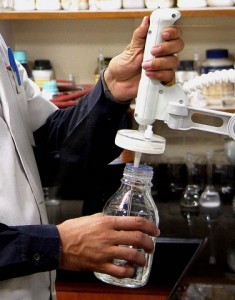
Quality Water for HPLC Analysis
HPLC is a reliable and established technique used in laboratories to separate, identify, and quantify components in a mixture. In HPLC analysis, water is used in mobile phases and sample preparation. Water is a universal solvent as it dissolves most substances, but ordinary tap water cannot be used for laboratory applications due to the presence of contamination.
Water contaminants include dissolved atmospheric gases, natural minerals and organic substances, dissolved solids and suspensions and bacteria or microorganisms if the necessary nutrients and environmental conditions are present to support them.
Water for laboratory use requires different degrees of treatment for required applications. Reagent grade water is defined as water suitable for use in a specified procedure such that it does not interfere with the specificity, accuracy and the precision of the procedure. General laboratory applications include glassware washing and rinsing, reagent and buffer solution preparation, making blanks and standard solutions for calibration purposes, etc.
Ultra-pure or HPLC grade water or ASTM specified Type 1 water is used for HPLC analysis.
With appropriate chromatographic detectors, compounds in trace concentrations as low as parts per trillion (ppt) can easily be identified. HPLC techniques can be applied to samples such as environmental, forensic, pharmaceuticals, food, and industrial chemicals.
What Is HPLC Grade Water?
HPLC grade water is ultra-pure water with low UV-absorbance wherein specific conductivity (16-18 meha ohms) is maintained by water purification systems. They are often filtered through a 0.22-micron filter and sealed in solvent-rinsed containers under an inert atmosphere to avoid contaminations.
HPLC Water Standard
According to the Japanese Standard Association Group, water used for HPLC analysis should be purified by a combination of reverse osmosis, ion-exchange, distillation, filtration, ultraviolet irradiation, and other methods.
The Japanese Industrial Standard on general rules for high-performance liquid chromatography states that HPLC water must have a quality that it does not interfere with the analysis. Also, the HPLC grade water must be evaluated based on index value such as total organic compound (TOC), specific resistance, and absorbance values.
What Is the pH of HPLC Water?
In HPLC and other laboratory work, maintaining a stable and reproducible pH is vital for accurate results. When dealing with ultrapure water, you cannot simply assess the pH with lab electrodes that detect ions in the water to determine the pH. HPLC water is the ultrapure water that contains a low and unstable level of ions, making the electrode reading unreliable.
Also, the pH of ultrapure water can be easily influenced by the CO2 present in the air as it easily diffuses into the solution. However, conductivity and resistivity can be correlated to predict the pH range of the solution. The resistivity of the HPLC water decreases as pH shifts beyond 7.
Type 1 Water Specifications
Reagent water has quantitative specifications to describe the purity of water. These specifications have been described by the American Society for Testing and Materials (ASTM). Type 1 water is also referred to as ultra-pure water that requires mixed bed deionization and filtration with 0.2μ membrane filters. The standard specifications for Type 1 water are outlined here:
| Resistivity | >18 megohms(mΩ)at 250C | | --- | --- | | TOC | < 5ppb | | Silica | <3ppb | | Sodium | <1ppb | | Chloride | <1ppb | | Bacteria | |
Applications like water for HPLC and trace metal analysis require water of highest purity as specified under Type 1 by ASTM. HPLC water is needed at the time of preparation of aqueous mobile phases, buffers, and solutions of samples and standards. Laboratories can either source HPLC grade water from solvent suppliers or install a water purification system.
Often, chromatographers use HPLC-grade bottled water for aqueous mobile phase preparation. The bottled ultrapure water has been found to have high levels of TOC (Total Organic Carbon) which can adversely affect the chromatograms of water with numerous and high background peaks.
Influence of Water contaminants on HPLC operation
Contaminants in water can affect HPLC’s work in many ways. Let us briefly examine in what ways contaminants in water for HPLC can affect your runs:
Solid P****articles
Solid particles of size above the permitted limits can damage pumps and injectors. They can decrease column life through increased wear and tear of seals, valves, and pump piston. In the long run, blockage of column frits could increase column back pressure leading to slow down and even complete stoppage of the mobile phase.
Colloids
Colloids may irreversibly adsorb on the stationary phase and reduce its efficiency of column separation.
Organics
Organic contamination of HPCL water may affect chromatographic separations in several ways:
Accumulation of organic molecules on the surface of chromatography column beads can reduce the access of sample and solvent molecules to the binding sites on the stationary phase resulting in loss of resolution.
The presence of organic molecules in water used for chromatographic separations can reduce the sensitivity of analytical chromatography. This can happen because organic molecules in the water used as an eluent may compete with the sample molecules for binding to the active groups on the chromatography beads. As a result, fewer sample molecules are released during the elution process.
Organics can also contribute to extraneous ghost peak(s).
If a high level of organic contamination is present, the contaminants can behave like a new stationary phase, resulting in retention time shift and peak tailing.
Ionic S****pecies
Ions can also affect chromatographic separations. Any modification in the ionic strength of the solution can affect the sequence of separation of polar molecules. Also, the UV-absorbing ions like nitrates and nitrites can come out as ghost peaks, thereby making the data analysis difficult.
Leachables
Storage of high quality of water often introduces leached compounds from containers. Plastic containers can leach out organics whereas glass containers can introduce ions on long term storage of HPLC mobile phases or buffers.
Gases
Dissolved air in mobile phase results in formation of minute bubbles under high pressures encountered in the HPLC water system. Such bubbles contribute to detector noise and voids in the column.
It is therefore absolutely necessary to filter the mobile phase and buffers at time of preparation and before pumping using on line filters. Degassing using on-line degassing or external techniques is equally important.
Commercial Sources of HPLC W****ater
Reputed suppliers of chemicals and reagents provide water for HPLC in bottles but in the long run it is advisable and economically viable to install commercially available dispensing units which will cater to your water requirements for other sophisticated analytical techniques besides HPLC.
Such systems are designed for large volume outputs and provide other useful features such as hand held controlled dispensing, sensors to indicate levels inside internal storage tank and prevent external spillages.
System components normally include pre- and post filtration capsules for removal of dissolved solids above 0.2 μ size. Activated carbon filters provide freedom from organics and dissolved chlorine. Mixed –bed deionizers control conductivity and UV irradiation source removes organic traces. Reverse osmosis system and a water storage tank complete such systems.
What source of water for HPLC do you use in your lab? How do you store bottled HPLC water? Have you faced any challenges with water quality? Share with us in the comments below.
What is the right quality of water for HPLC analysis?
HPLC requires ultra-pure, HPLC grade water, equivalent to ASTM Type 1 water, with specific conductivity maintained around 16-18 megohms and low UV absorbance. It is typically filtered through a 0.22-micron filter and sealed in solvent-rinsed containers under an inert atmosphere to avoid contamination.
Why can't ordinary tap water be used for HPLC?
Tap water contains contaminants such as dissolved atmospheric gases, natural minerals and organic substances, dissolved solids and suspensions, and bacteria, all of which can interfere with the specificity, accuracy, and precision of HPLC analysis.
What are the ASTM Type 1 water specifications?
ASTM Type 1 water must have a resistivity greater than 18 megohms at 25 degrees C, TOC below 5 ppb, silica below 3 ppb, sodium below 1 ppb, and chloride below 1 ppb, and requires mixed-bed deionization plus filtration through 0.2-micron membrane filters.
How do contaminants in water affect HPLC results?
Solid particles can damage pumps and injectors and raise column back pressure, colloids can irreversibly adsorb on the stationary phase, and organics can reduce resolution and sensitivity while producing ghost peaks. Ionic species can shift separation order and appear as ghost peaks, while dissolved gases can form bubbles that cause detector noise and column voids.
Can the pH of HPLC water be measured with a standard electrode?
No. Because ultrapure HPLC water has a low and unstable level of ions, standard pH electrodes give unreliable readings, so conductivity and resistivity measurements are instead used to predict the pH range, since resistivity decreases as pH shifts beyond 7.
Where can laboratories source HPLC grade water?
Laboratories can purchase HPLC grade water in bottles from chemical and reagent suppliers, or install a purification system combining pre- and post-filtration, activated carbon filters, mixed-bed deionizers, UV irradiation, and reverse osmosis, which is more economical for high volume, long-term use.