
Atomic Absorption Analysis
During Atomic Absorption analysis, an aspirated liquid sample passes through a flame divided into three zones, the primary combustion zone, the atom-rich inter-zonal region, and the secondary combustion zone, where it is progressively desolvated, vaporized, and thermally dissociated into the ground-state atoms that absorb characteristic wavelengths of light from the source, all within about 10-3 seconds of residence time.
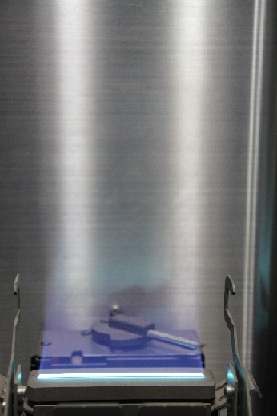
Most of you would have observed the changes in colour of the Atomic Absorption Spectroscopy flame on aspiration of sample into it and wondered as to what processes lead to such changes.
| 
AAS Flame with Blank Introduction | 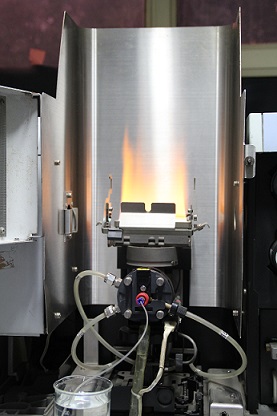
AAS Flame with Sample Introduction | | --- | --- |
A brief introduction to the phenomena has been made in the article Air or Nitrous oxide – which is the right oxidant gas for flame Atomic Absorption Spectroscopy analysis. The present article discusses the processes in further detail. However, before understanding these processes it is important to have an understanding of the Atomic Absorption Spectroscopy flame structure.
Flame Structure
The appearance and relative sizes of the three zones depend on choice of fuels and oxidants and also on their respective proportions.
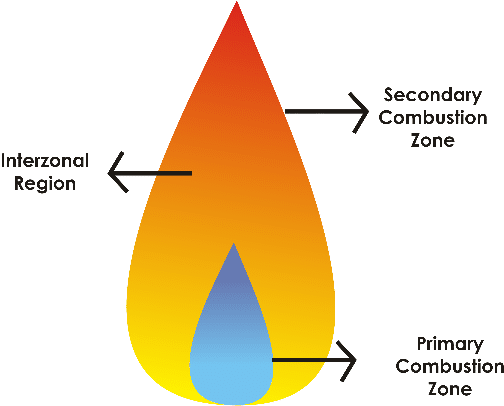
Zones of Flame
Primary combustion zone is close to burner tip and has a blue luminiscence. It contains non-atomised molecules and fuel species such as C₂ and CH
Inter zonal region is rich in free atoms and is the preferred region for Atomic Absorption Spectroscopy analysis. It is also the hottest zone of the flame.
Secondary combustion zone is the outer zone. It is rich in reformed species as temperatures are lower than in the core.
As temperature within the flame varies the signal sensitivity also depends on flame height. Flame height adjustment helps isolation of best absorption intensity signals. Further as the burner slot is of a linear design rotation of burner had also helps in signal intensity adjustments.
Flame Processes
The liquid sample enters the flame as fine droplets after nebulization in the spray chamber. Due to the high temperature the solvent evaporates and leaves solid salts or crystals behind. The solid particles melt and molecular vapour is formed. In the higher temperature region thermal dissociation of molecular vapour takes place and a mix of ground state and ionized atoms results. The ground state atoms are responsible for absorption of characteristic light wavelengths reaching from the light source. The entire sequence is completed in about 10-3 sec (residence time of sample in flame).
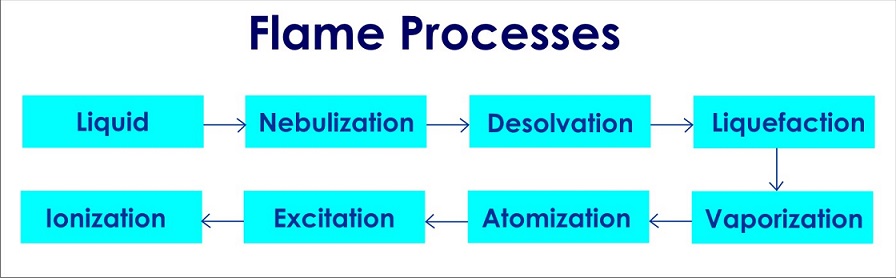
Flame Processes
Majority of elements are analyzed using air – acetylene flames having temperatures in the range of 2150°C – 2300°C. However, hotter flame temperatures of 2600°C – 2800°C using nitrous oxide-acetylene combination are required for analysis of refractory elements which form stable oxides which do not decompose at the air-acetylene flame temperatures.
Hope you found the article informative and interesting. We shall be obliged if you offer your valued comments.