
Which Is a Better Choice? ICP-OES or ICP-MS
ICP-OES and ICP-MS are the two leading techniques for trace and ultra-trace metal estimations, and choosing between them depends on factors such as budget, required detection limits, dissolved-solids tolerance, and whether isotopic analysis is needed.
ICP-OES and ICP-MS are preferred techniques for trace and ultra-trace metal estimations. Merits and demerits of both techniques alongwith Graphite furnace Atomic Absorption Spectroscopy have been discussed earlier.The present article will help you decide between the two based on your budget and analysis requirements.
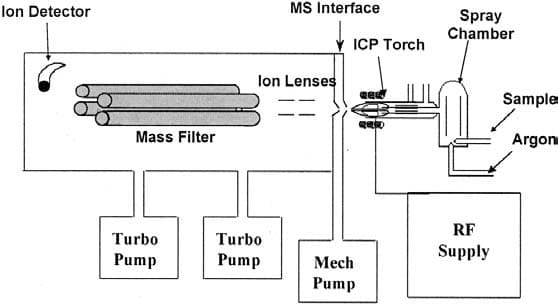
ICP-MS Schematic Diagram (Image Courtesy : http://biochem.pepperdine.edu/)
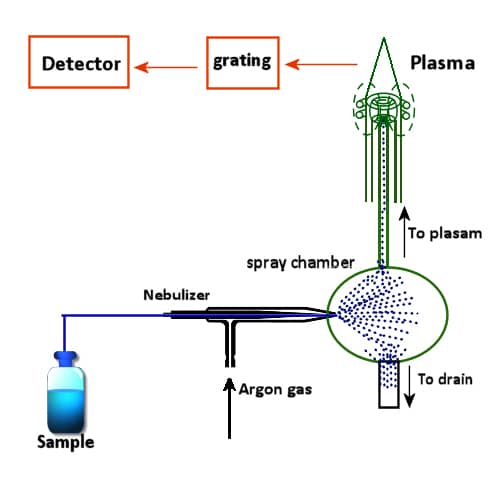
ICP-OES Schematic Diagram (Image Courtesy : http://www.chemiasoft.com/)
Initial Cost
The initial cost is a limiting factor for most laboratories. However, the cost can be weighed against requirements of level of sophistication, sample handling capabilities, automation and software features. Generally, the initial investment on ICP-MS will be higher but it is difficult to quantify as the quoted price will be dependent on accessories and the backup support offered by the supplier.
Operational Cost
ICP-MS requires greater maintenance due to limited lifetime of some critical components. The cost can escalate further for ultra trace analysis because of requirement of clean room and ultra pure reagents. Operation Skills
Both ICP-OES and ICP-MS are highly sophisticated techniques but ICP-MS does require special operator skills. However, user friendly softwares available today have reduced the gap.
Concentration Range
The working range for routine determination is an important deciding factor. Both techniques require sample introduction in liquid form .ICP-OES is suitable over concentrations from 0.0002 to 1000ppm whereas ICP-MS is capable of ultra-trace determinations from 0.0005 to 100ppb.
Total Dissolved Solids
ICP-OES is capable of handling samples with a total solids content upto 20%. In comparison ICP-MS is limited to about 0.2%for trouble free operation. This makes ICP –OES a preferred choice for analysis of geological and other inorganic materials.
Sample Size
Sample availability is often a limiting factor. ICP-OES has sample requirement generally from 0.1 to 1.0g but ICP-MS can be used when smaller sample sizes from 0.01-0.1g are available.
Elemental Range
ICP-MS provides analysis of elements from Li- U except for C,H,O, N and noble gases. ICP-MS can be used for same elemental determinations with the exception of S.
Linear Dynamic Range
ICP-MS offers a wider linear dynamic range of 108 whereas ICP-OES is lower 106.
Sample Throughput
Both techniques give high sample throughputs with capabilities of upto 40 elements /minute in each sample. The turn-around time between samples ranges from 3-5 mInutes.
Isotopic Analysis
ICP-MS has a distinct advantage as detection is based on mass to charge ratios thereby enabling determinations of isotopes of same element. Such estimations are important for environmental and pharmaceutical studies where different isotopes of same element can have adverse health impacts.
In short you have to keep in mind your present and future applications in mind .Demands of applications and skill requirements besides cost implications are key considerations that you should keep in mind before you make your choice on procurement of such highly sophisticated techniques.
Which is a better choice, ICP-OES or ICP-MS?
The choice depends on budget and analysis requirements. ICP-MS generally has a higher initial cost and greater maintenance needs but offers ultra-trace detection and isotopic analysis, while ICP-OES is more economical, handles higher dissolved solids, and suits geological and other inorganic materials.
How do the concentration ranges of ICP-OES and ICP-MS compare?
ICP-OES is suitable for routine determinations from about 0.0002 to 1000 ppm, while ICP-MS is capable of ultra-trace determinations from about 0.0005 to 100 ppb, making ICP-MS the better choice for lower-level trace analysis.
Which technique handles higher total dissolved solids?
ICP-OES can handle samples with a total dissolved solids content of up to about 20%, whereas ICP-MS is limited to roughly 0.2% for trouble-free operation, which makes ICP-OES the preferred choice for geological and other inorganic materials.
Can ICP-MS perform isotopic analysis?
Yes. Because ICP-MS detection is based on mass-to-charge ratio, it can distinguish isotopes of the same element, which is important for environmental and pharmaceutical studies where different isotopes can have different health impacts.
How do sample size requirements differ between the two techniques?
ICP-OES generally requires larger sample sizes of about 0.1 to 1.0g, while ICP-MS can work with smaller samples of about 0.01 to 0.1g, which is useful when sample availability is limited.
What is the difference in linear dynamic range between ICP-OES and ICP-MS?
ICP-MS offers a wider linear dynamic range of about 10 to the 8th power, compared to the lower range of about 10 to the 6th power offered by ICP-OES.