
Why is Leak checking necessary before starting Gas Chromatography analysis?
Leak checking is the pre-analysis inspection of every gas connection in a GC system, from the cylinder and regulator through fittings, adapters, and connectors inside the column oven, for line leaks, which if left unchecked cause gas loss, shifting retention times, detector noise, and irreversible column damage from oxygen ingress.
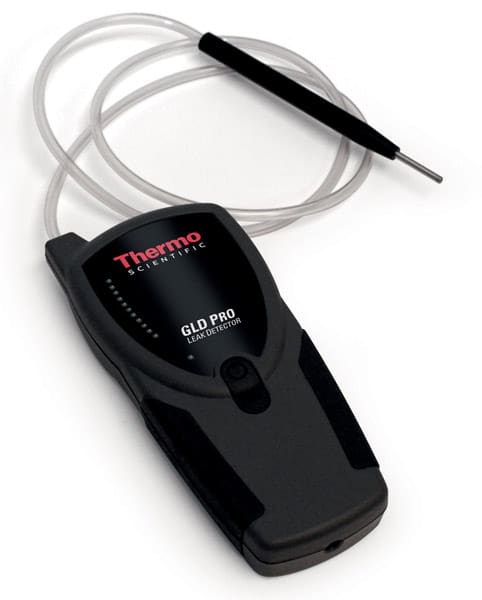
Gas Leak Detector
Photo Courtesy : www.pharmaceutical-int.com/
A Gas Chromatographic system which is ready for analysis should be free of line leakages to give precise results every time under identical conditions. Gas leaks can be frustrating due to the following reasons:
- Leaks lead to loss of expensive high-quality gases
- Flow changes due to leaks result in shifting of peak positions due to changes in retention times
- Detector noise and unstable baselines
- Reduction in useful life of the column traps
- Irreversible damage to column packing if exposed to oxygen entering through leaks at high operation temperatures
- Need for greater detector maintenance
Let us now consider the potential leak points in the Gas chromatographic system. One should check for leaks at the gas source (gas cylinders), regulators, fittings, adapters and connectors down the line and even all fittings and connectors within the Gas Chromatography column over. Remember to turn off the oven fan when checking Gas Chromatography column leaks. Unlike HPLC where leaks become visible the leaks of gas chromatography system can go unnoticed if leak detection devices are not used.
Conventionally soap or detergent solutions have been used to detect leaks but due to venturi effect such solutions can be sucked in and lead to column contamination. The other convenient alternative is to use portable hand-held detectors generally based on the principle of thermal conductivity. These are relatively in expensive devices which have sensors capable of access to every nook and corner of the Gas Chromatograph and do not lead to system contamination. In high sensitivity detectors such as mass spectrometer argon gas is sprayed around fittings and connections and monitoring is conducted for mass 40. Otherwise one can even monitor for nitrogen (mass 28) or oxygen (mass 32) by the mass sensitive detector.
Reliable inexpensive leak detectors are available from a number of manufacturers some of which are listed here:
Leak detection should be adopted as a regular laboratory practice every time you change a cylinder or the Gas Chromatography column and before conditioning the column prior to start of analysis.
Please leave your comments and share your experiences.
Why must a GC system be checked for leaks before starting analysis?
A gas chromatographic system that is ready for analysis should be free of line leakages so it gives precise results every time under identical conditions.
What problems can gas leaks cause in a GC system?
Leaks cause loss of expensive high-quality gases, shifting of peak positions due to changes in retention times, detector noise and unstable baselines, reduced useful life of the column traps, irreversible damage to column packing if oxygen enters at high operating temperatures, and a greater need for detector maintenance.
Where are the potential leak points in a GC system?
Leaks can occur at the gas source or cylinders, regulators, fittings, adapters and connectors down the line, and even at fittings and connectors within the GC column oven.
Why should the oven fan be turned off when checking for leaks?
You should remember to turn off the oven fan when checking Gas Chromatography column leaks, since unlike HPLC, where leaks become visible, gas chromatography leaks can go unnoticed if leak detection devices aren't used.
Why should soap or detergent solutions be avoided for leak detection?
Soap or detergent solutions have conventionally been used to detect leaks, but due to the venturi effect such solutions can be sucked into the system and lead to column contamination.
How are leaks detected in high-sensitivity systems such as GC-MS?
Portable hand-held detectors based on thermal conductivity are a convenient, inexpensive alternative that can access every part of the instrument without contaminating it. In high-sensitivity detectors such as a mass spectrometer, argon gas is sprayed around fittings and connections while monitoring for mass 40, or nitrogen (mass 28) and oxygen (mass 32) can be monitored instead.