
Why is it Essential to regulate Visitor entry to your Laboratory?
Regulating visitor entry to a laboratory means controlling who may access its tightly monitored environment, since uncontrolled outsider access threatens both contamination of test conditions and the security of samples, equipment, and confidential materials.
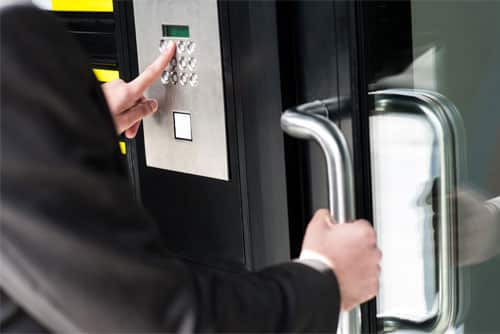
Code secured door entry
Your laboratory is a controlled environment where conditions such as temperature, humidity, air- conditioning, external vibrations, biological sterility, stable power supply, etc need careful monitoring and control to get consistency of results day after day. Clause 5.3 of ISO 17025:2005 on Accommodation and Environmental conditions provides general guidelines but does not provide specific guidance on access to the laboratory by outsiders. Laboratories have the liberty to adopt the practices based on their individual circumstances.
The need for exercising control on visitor access arises mainly for two reasons, namely, prevention of contamination and security. The present article will introduce you to measures that you can adopt depending on your laboratory requirements and the nature of activities carried out.
First of all you should analyze what categories of visitors are likely to visit your laboratory and ascertain their visit objectives in advance. Ideally the laboratory should be kept out of bound because visitors can be a source of distraction, pilferage or contribute to contamination but there will be occasions when such visits will become unavoidable. Let us begin by listing out the type of visitors which you can expect
- Management and staff working in other sections
- Auditors
- Clients
- Trainees
- Maintenance personnel including service engineers
- Housekeeping and sanitation staff
The article suggests some measures that you can adopt to regulate access to your laboratory without compromising on environmental contamination or laboratory security.
Laboratory Environment
Protective clothing – all visitors should be made to wear prescribed protective clothing, shoe- covers, and head covers so that external dust or contamination is not carried inside the laboratory. This should apply universally to all visitors including internal staff, management, auditors and trainees
Double door entry – sensitive areas of the laboratory should be provided double door entry with air curtain installed in the intervening space
Sample access – A visitor should not be permitted to handle any test sample to prevent contamination or even theft/ replacement by interested persons.
Laboratory Security
Laboratory security is also a major concern and gives rise to the need to regulate visitor access. Some measures you can adopt are suggested below:
Authorization – every visitor must have a valid reason for visiting the laboratory. Visit requests should be routed through a dedicated person.
Monitoring – before granting entry visitor credentials should be verified and stored electronically. These should include details of organization, purpose of visit, contact number, person to be contacted and purpose of visit. It is necessary to keep a record of his/her movements inside the premises with the help of CCTV’s. Visitor should be checked physically so that no dangerous material is carried inside the laboratory.
Staff credentials verification – it is important to verify the credentials of housekeeping and sanitation staff and ensure that they have no vested interests
**Limited access –**Access to areas that house confidential documents or highly dangerous materials should be authorized only through digital locks with secret codes
Modern technology has provided means of surveillance such as CCTV’s with or without voice recording but as far as possible visitors should not be left alone in the laboratory and someone should be deputed to accompany or liaise with them during their presence. This will prevent pilferage is or even mishaps resulting in injury through contact with hazardous laboratory materials or equipment due to non-familiarity with the premises.
Why is it essential to regulate visitor entry to a laboratory?
A laboratory is a controlled environment where conditions such as temperature, humidity, air-conditioning, external vibrations, biological sterility, and stable power supply need careful monitoring to ensure consistency of results. Regulating visitor access is necessary mainly for two reasons: prevention of contamination and security.
What does ISO 17025:2005 say about visitor access to laboratories?
Clause 5.3 of ISO 17025:2005, on Accommodation and Environmental Conditions, provides general guidelines but does not give specific guidance on access to the laboratory by outsiders, leaving laboratories the liberty to adopt practices based on their individual circumstances.
What categories of visitors typically enter a laboratory?
Common categories include management and staff from other sections, auditors, clients, trainees, maintenance personnel including service engineers, and housekeeping or sanitation staff.
What measures protect the laboratory environment from visitor-related contamination?
All visitors, along with internal staff, should wear prescribed protective clothing, shoe-covers, and head covers. Sensitive areas should have double door entry with an air curtain installed in the intervening space, and visitors should never be permitted to handle test samples.
How should laboratory security be managed for visitors?
Every visitor should have a valid, authorized reason for visiting, with requests routed through a dedicated person. Before entry, credentials should be verified and stored electronically, movements should be recorded with CCTVs, and visitors should be checked physically to ensure no dangerous material is carried inside.
Should visitors ever be left alone inside a laboratory?
No, as far as possible visitors should not be left alone; someone should be deputed to accompany or liaise with them to prevent pilferage or mishaps resulting from unfamiliarity with hazardous materials or equipment.