
What is the basis of colour of substances?
The colour of a substance arises from both its physical characteristics, namely absorption, diffuse reflectance, and light scattering, and its chemical characteristics, namely the presence of chromophores that undergo electronic transitions when irradiated with light.
Colours all around us do fascinate us but have you ever wondered that even though the natural light is colourless then what it is that imparts different colours to different materials. In reality the colourless light that we see is composed of different colours. All of you would have seen the resolution of colourless beam of light into its constituent colours when it passes through a prism. The basic realization that white light is actually composed of different colours is the starting point that will provide answer to the basic question on what is responsible for the colour of materials.
Colour of a material arises from both physical and chemical characertistics and these are discussed in the present article.
Physical Characteristics
Absorption
A liquid or solid medium which is transparent will transmit all the constituent colours of white light without resolving them and will appear colourless. A medium which selectively absorbs some colours but reflects or transmits other colours will appear to be coloured. The colours which are transmitted or reflected are referred to as complimentary colours.A Complementary colour wheel depicts the colour of the material on absorption of wavelengths that appear on the wheel diagonally opposite to the colour of appearance.

Composite colours of white light
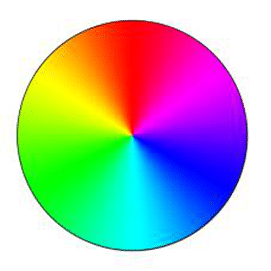
Complimentary colour wheel
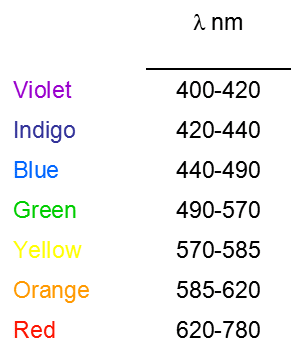
Wavelengths of colours comprising white light
Intensely absorbing molecules that absorb specific wavelengths are known as pigments or dyes. Inorganic pigments come in the form of polycrystalline powders or agglomerates commonly dissolved in soluble oils. On the other hand organic pigments are much more prevalent in nature. Examples are red colour of hemoglobin and the green of chlorophyll in plants and leaves.
Diffuse Reflectance

Coloured polymeric granules and sheets
Rough surfaces reflect incident light back in multiple directions. Common salt appears white as its crystals reflect light without absorption. On the other hand, copper sulphate crystals appear blue as they absorb higher wavelengths such as red to yellow to green and reflect the blue wavelengths
Light Scattering
Light is scattered by particles in its path. A classical example is blue appearance of the sky. The blue wavelengths of the incident sunlight are scattered more strongly than the red wavelengths by particles smaller in size than the wavelengths of light. Larger particles or pollutants having diameters of the order of light wavelengths or even larger in the atmosphere scatter light in the forward direction and scattering is not much colour dependent and therefore clouds or pollution plumes generally appear to be hazy white.
Chemical Characteristics
All matter is composed of atoms or groups of atoms arranged in different molecular configurations. Some of these arrangements or functional groups are responsible for colours of compounds. Such groups are referred to as Chromophores. A chromophore is capable of electronic transitions in the UV – visible spectral region when irradiated with light and thereby imparts colour to the compound.Some typical examples are ß-carotene, quinonones, porphyrins and azo dyes.
What is the basis of the colour of substances?
Colour arises from both physical characteristics of a material, namely absorption, diffuse reflectance, and light scattering, and its chemical characteristics, namely the presence of chromophores that undergo electronic transitions when irradiated with light.
How does absorption give a substance its colour?
A medium that selectively absorbs some colours of white light while reflecting or transmitting others appears coloured, with the transmitted or reflected colours referred to as complementary colours. Intensely absorbing molecules of this kind are known as pigments or dyes, such as the red of hemoglobin and the green of chlorophyll.
Why does common salt appear white while copper sulphate crystals appear blue?
Common salt crystals reflect incident light in multiple directions without absorbing it, so they appear white. Copper sulphate crystals, by contrast, absorb higher wavelengths such as red, yellow, and green and reflect the blue wavelengths, giving them their blue colour.
Why does the sky appear blue?
The blue wavelengths of sunlight are scattered more strongly than the red wavelengths by particles smaller than the wavelength of light, which is the classical example of light scattering imparting colour.
Why do clouds or pollution plumes appear white or hazy rather than coloured?
Larger particles with diameters on the order of, or larger than, the wavelengths of light scatter light mostly in the forward direction in a way that is not strongly colour dependent, so clouds and pollution plumes generally appear hazy white.
What is a chromophore?
A chromophore is a functional group or arrangement of atoms capable of electronic transitions in the UV-visible spectral region when irradiated with light, thereby imparting colour to the compound. Typical examples include beta-carotene, quinones, porphyrins, and azo dyes.