
Analysis Techniques
Radioanalytical techniques are analytical methods that exploit radioactive decay or induced radioactivity, such as neutron activation, to identify and quantify trace elements and compounds, complementing spectroscopic techniques based on nuclear energy level transitions.
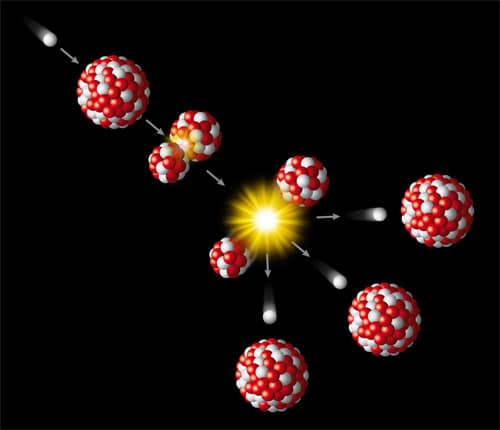
Radioactive Decay - Basis of Radioanalytical Techniques
Spectroscopic analysis based on changes in nuclear energy levels dealt with a couple of techniques based on excitation of nuclear energy levels by electromagnetically radiation. In the present article you will be introduced to analytical techniques involving excitation and emission of radioactivity
Common techniques involving radioactive measurements are:
- Radiotracer techniques
- Isotope dilution analysis
- Nuclear activation analysis
- Radiometric titrations
- Radiochromatography
- Radioimmunoassay
Radioactive measurements can be made on samples comprising of such components or alternately by inducing radioactivity into the system by external excitation
Radiotracer Techniques
A radiotracer is a radioactive material which is used as a marker which does not cause any radiation damage to the system into which it is introduced and helps locate itself over a period of time. The half life of the radio tracer plays an important role in its selection. It should be long enough to last the monitoring but longer half life will lead to problems of disposal or environmental contamination.
Isotope Dilution Analysis
Isotope dilution analysis is based on the principle that the activity of the radio isotopes in a mixture of compounds remains unchanged during chemical processing such as precipitation, solvent extraction, ion exchange separation, etc. Quantitative recovery of the radioactive isotope is not necessary for its estimation as radioactive strength will remain unchanged during the chemical processing.
The technique has been used largely for trace element analysis in biological, environmental, geological and archaeological investigations.
Neutron Activation Analysis
Neutron activation analysis is a high sensitivity nondestructive technique for identification and quantitation of trace elements which become radioactive after irradiation with neutrons. The energy transitions responsible for generation of artificial radioisotopes takes place at the nuclear level and the emitted radiations are sensed by scintillation or a semiconductor detector.
Nuclear activation analysis has been applied to compositional analysis of archaeological artifacts, soils, minerals and semiconductors when the amount of sample available is limited or nondestructive testing is necessary.
Radiometric Titrations
Radiometric titrations are based on addition of a radiotracer to the titrant. It has no role in the chemical reaction but serves to detect the endpoint. At the end point there is a spike in the radioactive level. The greatest advantage is titration even in those cases where conventional indicators are not available. The main area of application is precipitation reactions in which phase separations takes place during the titration
Radiochromatography
Radio chromatography has been applied to separations mainly based on thin layer chromatography or electrophoresis. A radiolabelled species such as cation, anion or organic compound is identified and quantified on the measurement of emitted radio activity. The distribution of radioactivity over the separation zones serves to monitor the separation
Radioimmunoassay
Radioimmunoassay is a highly specific and sensitive technique capable of measuring analytes down to femtomole levels. It is based on specific reaction between a radiolabelled antigen and an antibody. Such reactions form the basis of development of immunoassays for estimation of biomolecules such as steroids, harmones, viruses and bacteria in body fluids.
Radioanalytical methods offer high sensitivity and specificity because of independence from chemical interferences. In subsequent articles you will be introduced to other group of techniques based on different physicochemical properties.